
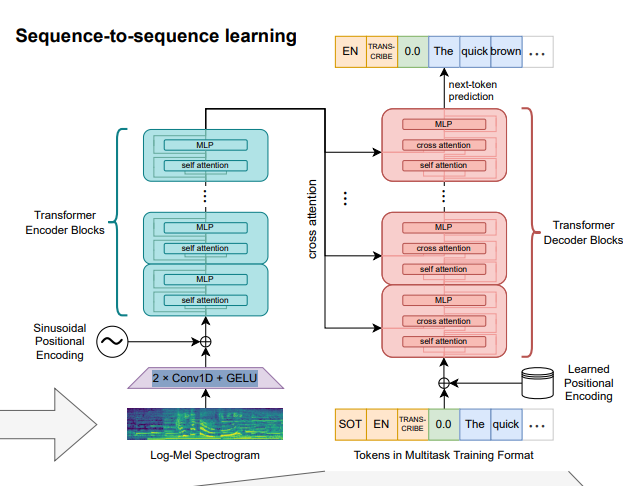
Paper: https://cdn.openai.com/papers/whisper.pdf
Whisper must:
- Convert raw audio into text
- Work on long audio (minutes to hours)
- Handle unknown languages
- Avoid cutting words or sentences at fixed boundaries
The design choices you see (30‑second windows, timestamps, seek logic, prompts) are all answers to these constraints.
1. High-Level Pipeline
Audio → Log‑Mel Spectrogram → 30s Window
      → Encoder (once per window)
      → Decoder (token-by-token loop)
      → Tokens + Timestamps
      → Smart Seek → Next Window
Everything else is detail.
2. Entry Point: transcribe()
The transcribe() function orchestrates the entire process.
2.1 Audio Normalization
- Audio is converted into a log‑mel spectrogram
- If audio < 30s → pad with silence to exactly 30s
Why?
- The model is trained on fixed-size inputs
- Variable-length inputs complicate batching and attention masks
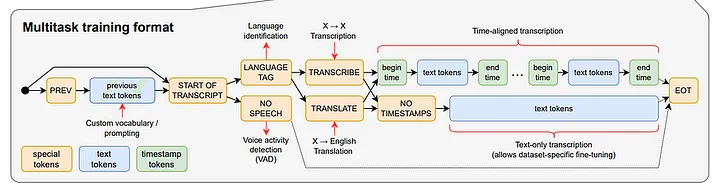
3. Language Detection (Before Transcription)
Whisper must decide which tokenizer and decoding mode to use.
3.1 Key Insight
Whisper does not use a separate language classifier.
Instead:
It forces the main decoder to reveal the language using a single-token trick.
3.2 The One‑Token Trick
- Take the first 30s spectrogram
- Feed the decoder only:
<|startoftranscript|>
- Run one forward pass
- Mask out all tokens except language tokens:
<|en|>, <|fr|>, <|de|>, ...
- Pick the highest‑probability survivor
mask[list(tokenizer.all_language_tokens)] = False
logits[:, mask] = -np.inf
language = logits.argmax(dim=-1)
Why this works:
- Whisper is trained to always emit a language token immediately after
<|sot|>
4. Windowing Strategy (Why 30 Seconds?)
Whisper processes audio in overlapping 30‑second windows.
Why 30s?
- Fits GPU memory
- Long enough for semantic context
- Short enough for fast iteration
But fixed windows introduce a dangerous problem:
What if a word or sentence crosses the 30s boundary?
This is solved later using timestamps + smart seek.
5. The Encoder — “The Ears”
The Encoder converts sound → meaning.
5.1 Input
- Source:
audio.py → log_mel_spectrogram() - Shape:
(batch, 80, 3000)
- 80 = Mel frequency bins
- 3000 = 30s ÷ 10ms frames
This is an image of sound.
5.2 Compression (The Zipper)
Inside AudioEncoder.forward():
- Conv1d #1
- Expands channels →
n_state(e.g. 512)
- Expands channels →
- GELU non-linearity
- Conv1d #2 (stride = 2)
- Halves time resolution
Result:
(batch, 512, 1500)
Interpretation:
- Each encoder token ≈ 20ms of audio
- Audio becomes 1500 audio tokens
5.3 Positional Embedding
- Added to tell the model when sounds happened
- Without it, attention would be time‑agnostic
5.4 Self‑Attention Blocks
- Multiple
ResidualAttentionBlocks - Every audio moment can attend to every other moment
Example:
- Noise at 5s can influence word interpretation at 6s
5.5 Encoder Output
Final result:
AudioFeatures
Shape: (batch, 1500, n_state)
This is meaning without words.
6. The Decoder “The Writer”
The Decoder converts meaning → text.
It runs autoregressively (one token at a time).
6.1 Decoder Inputs
AudioFeatures(from Encoder)- Tokens generated so far
Initial tokens look like:
[<|sot|>, <|en|>, <|transcribe|>]
6.2 Decoder Anatomy
Each decoding step contains:
- Self‑Attention (text memory)
- Cross‑Attention (audio lookup)
- MLP + projection → logits
6.3 Cross‑Attention (The Critical Bridge)
x = x + self.cross_attn(
    self.cross_attn_ln(x),  # text query
    xa,                     # audio features
)[0]
Mental model:
- Text asks: “Given what I’ve written so far, which audio moment matters next?”
- Audio replies with the relevant slice
This is how words align to sound.
7. Token‑by‑Token Decoding Example
Phrase: “Welcome to New York”
Step 1 — “Welcome”
- Attention focuses on audio tokens ~0–50
- Output:
Welcome
Step 2 “ to”
- Attention shifts slightly forward
- Output:
to
Step 3 “ New”
- Attention moves deeper into the window
- Output:
New
Step 4 “ York”
- Continues until phrase ends
Note:
- Whisper tokens include spaces
8. Vocabulary & Tokenization
- Vocabulary stored in binary file:
whisper/assets/gpt2.tiktoken
- Loaded in
tokenizer.py - Maps base64‑encoded strings → token IDs
Includes:
- Words
- Subwords
- Spaces
- Timestamps
- Control tokens
9. The Hard Problem: 30‑Second Boundary Cuts
Naively splitting audio would cut words:
Ama|zing
Whisper avoids this using timestamps + smart seek.
10. Timestamps The Safety Mechanism
Whisper emits timestamps like:
<|28.00|> Hello world <|29.20|>
Important constraint:
The model only emits timestamps for completed phrases
If a word starts but doesn’t finish before 30s:
- No closing timestamp is emitted
11. Smart Seek “Predict, Then Rewind”
After decoding a window:
- Find the last valid timestamp
- Move the cursor (
seek) back to that point
last_timestamp = tokens[pos] - tokenizer.timestamp_begin
seek += last_timestamp * input_stride
Result:
- Window 1: 0–30s → text ends at 28s
- Window 2: starts at 28s → captures full word
No word is lost.
12. Context Memory Across Windows
Even though audio overlaps, text must remain coherent.
Whisper solves this with prompt carryover:
-
Previous text is injected as a hidden prefix
-
New window decoding is conditioned on past text
decode_options["prompt"] = all_tokens[prompt_reset_since:]This preserves:
- Grammar
- Capitalization
- Sentence flow
13. Final Mental Model
Whisper behaves like this:
“Listen to 30 seconds → understand → write until confident → rewind slightly → continue with memory.”