
Exponents
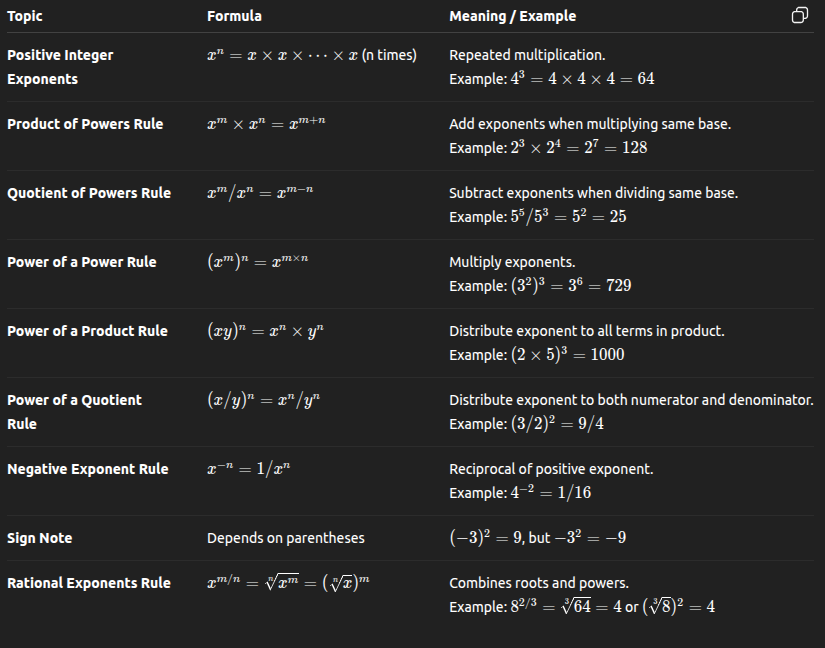
Euler’s Number
Imagine we have a magic jar that:
- Starts with 1 liter of potion
- Has the power to grow 100% full in 1 hour
- But instead of filling once at the end, it tries to grow a little bit multiple times within that hour
The more often we let it grow, the more potion you’ll end up with after 1 hour!
Case 1: Grow just once
- Only let it grow once at the end of the hour
- Potion =
1 + 100% of 1 = 2 liters
Case 2: Grow twice (every 30 minutes)
- Each time: grow by 50% of current
- Step 1 (after 30 mins):
- Step 2 (after 60 mins):
1.5 + 50% of 1.5 = 2.25
Case 3: Grow 4 times (every 15 minutes)
Now growth per step = 25%
- Step 1: 1 → 1.25
- Step 2: 1.25 → 1.5625
- Step 3: 1.5625 → 1.953125
- Step 4: 1.953125 → 2.44140625
| n (splits) | Result |
|---|---|
| 1 | 2.000000 |
| 2 | 2.250000 |
| 5 | 2.488320 |
| 10 | 2.593742 |
| 100 | 2.704814 |
| 1,000 | 2.716923 |
| 10,000 | 2.718146 |
| ∞ | 2.718281828… (e) |
Formula
(1 + 1/n)^ n
If something is growing at 100% per unit time, and you let it compound continuously (infinitely many tiny growths in that time), the maximum amount you can reach at the end of 1 time unit is:
e ~ 2.718...
Logarithmic
A logarithm is the inverse of exponentiation.
For example:
log base 2 of 8, written as
log₂(8), means:
“To what power must 2 be raised to get 8?”
The answer is 3, because:
2³ = 8
So,log₂(8) = 3
Exponent Review
Exponentiation means multiplying a number by itself a certain number of times:
2⁴ = 2 × 2 × 2 × 2 = 162⁻² = 1 / 2² = 1 / 4
Just like:
- Subtraction undoes addition
- Logarithms undo exponents
Inverse Relationship
If:
bʸ = x
Then:
log_b(x) = y
Where:
bis the basexis the resultyis the exponent
Use Cases of Logarithms
- Representing very large or small numbers in a compact form.
- Example:
log₁₀(1,000,000) = 6
- Example:
- Handling exponential growth or decay, such as in:
- Earthquake measurement (Richter scale)
- Sound intensity (decibels)
- Population growth
- Radioactive decay
- Making multiplication into addition, which simplifies calculations.
Common Bases
log₁₀(common logarithm): Often used in science and engineering.log₂(binary logarithm): Common in computer science.logₑorln(natural logarithm): Used in calculus and natural growth processes.
Log e?
To what power must e be raised to get x?
Example
Let’s say one day you walk into the lab and measure the size of the bacteria colony. It’s 10 times bigger than it was when you started.
“How long has it been growing to reach this size?”
To figure this out, we reverse the growth process that’s exactly what a logarithm does.
-
Since the growth is continuous, we use ln (log base e).
-
ln tells you “how long ago the colony was 1x its size” before it became 10x.
-
e^x = How much it’s grown after time
x -
ln(x) = How much time it took to grow to size
x
Trignomentry
Sin → to represent the vaule in vertical cos→ to represent the vaule in horzontal
Resources
- https://buttondown.com/jaffray/archive/adventures-in-probability/
- https://briefer.cloud/blog/posts/logarithms/
percentage
If you need a percentage of a number, just multiply the number by the percentage (written as a decimal). This method works for any percentage!
Find 15% of ₹5000.
- Convert 15% to a decimal:
15/100=0.15 - Multiply by the number (₹5000):
0.15×5000=₹750
So, 15% of ₹5000 is ₹750.
Numbers
- Little-Endian Format:
- The least significant byte (LSB) is stored at the lowest memory address (i.e., first).
- For example, a 16-bit number like 0x1234 would be stored as 0x34 followed by 0x12.
- 0x34 is the least significant byte, so it goes first.
- 0x12 is the most significant byte, so it goes second. In memory it will from reverse
Address 0x00 → 0x34
Address 0x01 → 0x12
-
This is common in many Intel-based systems.
-
Big-Endian Format:
- The most significant byte (MSB) is stored first, at the lowest memory address.
- Using the same example, 0x1234 would be stored as 0x12 followed by 0x34.
- Big-endian is often used in network protocols (also called network byte order) and some other computer architectures.
- is used in network protocols
IEEE 754 standard is used to represent numbers
In 32-bit floating point, the layout is:
- Sign: 1 bit
- Exponent: 8 bits
- Mantissa: 23 bits
1(sign bit) Mantissa(8bit) 2Exponent
In scientific notation (both in decimal and binary), we want numbers in the form:
Number=1.Mantissa×2Exponent
This standard form has 1 non-zero digit before the decimal point. It helps by:
- Maximizing Precision: Ensures the most significant bits are stored in the limited space.
- Simplifying Comparisons: Makes it easy to compare floating-point numbers.
- Avoiding Redundancy: Without normalization, numbers could have infinite representations like
10 = 10.0 = 0.0010 × 2^4.
Computers use binary (0s and 1s). In binary, the biggest digit is 1. So, to save space, IEEE 754 wants numbers in the form:
1 2^exponent fraction
This is like writing 3,000,000 as:
3.0×1063.0 \times 10^63.0×10⁶
In binary, 10 (1010₂) becomes:
1010 =1.010×2^3
This “pushes” the most important bits to the left, so the computer only needs to remember:
- The 1 before the decimal (it’s always there, so we don’t store it).
- The exponent (
3). - The fraction (
010).
so it stored as
0 10000010 01000000000000000000000
- Efficiency:
- One bit before the decimal ensures the stored value is “packed” with the most significant digits.
- Computers store the fractional part (Mantissa) after that leading
1.
- Standardization:
- Ensures that every number has a unique representation, avoiding ambiguity.
- Just like we write numbers in scientific notation like
1.23 × 10^4, IEEE 754 uses binary scientific notation.
- Implicit Leading 1:
- In IEEE 754, the leading 1 is implied and not stored.
- This “hidden bit” gives you 1 extra bit of precision for free!
Without normalization, the floating-point system wouldn’t be able to represent numbers as efficiently. The normalization step guarantees the floating-point format is consistent across numbers.
What Is a Function?
A function is a precise rule or mapping that connects one input to exactly one output.
A function
fmaps each elementxin a setAto a single elementf(x)in setB.
If f(x) = 2x + 3, then for every input x, we get exactly one output.
You earn ₹2 per hour, but you started with ₹3 in your pocket.
So, if x = 4 hours:
f(4) = 2×4 + 3 = 11 → You now have ₹11.
Linear Function?
A function is linear if it has the form:
f(x) = mx + b
mis the slope — tells how fast things change.bis the intercept — the starting value.
Because when you plot f(x) = mx + b on a graph, the result is a straight line.
- The rate of change (
m) is constant. - That means every step right in
xgives the same step up/down inf(x).
Slope models rate:
- Speed in physics
- Cost increase per item in economics
- Growth rate in population studies
Slope formula
m=x2−x1/y2−y1
NOTE:Algebra, particularly coordinate algebra, involves mapping relationships between variables in two dimensions (using x and y), and finding an equation that models that relationship so we can predict unknown values at any point. by using the function f(x)= mx+b
What Is Bias (Intercept)?
In a linear equation, the bias (also called the intercept) is the constant term added to the equation. It’s what allows the line to shift up or down on the graph meaning it doesn’t have to pass through the origin (0, 0).
The general form with bias is:
y=mx+b
Where:
- m is the slope (how steep the line is)
- b is the bias (intercept) — the value of y when x=0
Without bias, your model (line, plane, or hyperplane) must go through the origin (0, 0). But in real-world data, this is almost never the case.
But what if your data looks like this?
| x | y |
|---|---|
| 1 | 3 |
| 2 | 5 |
| 3 | 7 |
Here, you’d find the best-fit line is:
y=2x+1
That +1 is the bias — it adjusts the line upward to match the data.
Systems of Equations
Gaussian elimination, rank, and singular systems are in System of linear equation.
A system of equations is a set of two or more equations with the same variables, and you want to find values for those variables that satisfy all equations simultaneously.
2x+y=7
x−y=1
we want to find x and y values that work for both equations at the same time.
Example
Tom and Sarah have $30 combined. Tom has twice as much as Sarah. How much money does each have?
t= Tom’s money
s= Sarah’s money
Equation
t+s=30
t=2s
Substitute t=2s

2s + s = 30
3s = 30
s = 30/3 =  10

so s= 10

t = 2 * 10
t = 30
We have 3 methods to solve the problem
- Substitution Method
- Solve one equation for one variable.
- Substitute that expression into the other equation.
- Solve for the remaining variable.
- Elimination Method (Addition/Subtraction)
- Graphing Method (The solution is where the graphs intersect.)
Euclidean Geometry
Euclidean Geometry is the study of plane and solid figures based on axioms and theorems formulated by the ancient Greek mathematician Euclid around 300 BCE.
concepts
1. Points
- A point represents a location in space. It has no size or dimension.
- Real life: GPS coordinates are points representing exact positions on Earth.
2. Lines
- Lines are infinitely long and have no thickness.
- A line segment is part of a line bounded by two points.
- Real life: Railroad tracks, edges of a table.
3. Angles
- Formed by two rays sharing a common endpoint.
- Measured in degrees or radians.
- Real life: Angle of elevation to a tree to measure its height.
4. Triangles
- Three sides, three angles.
- Triangles are fundamental because any polygon can be divided into triangles.
- Types:
- Equilateral (all sides equal)
- Isosceles (two sides equal)
- Scalene (all sides different)
- Right triangle (one 90° angle)
- Real life: Bridges use triangular trusses for strength and stability.
5. Circles
- Set of points equidistant from a center.
- Key parts: radius, diameter, circumference.
- Real life: Wheels, gears, planetary orbits.
Sin , COS ,tan
Formula for right trigangle
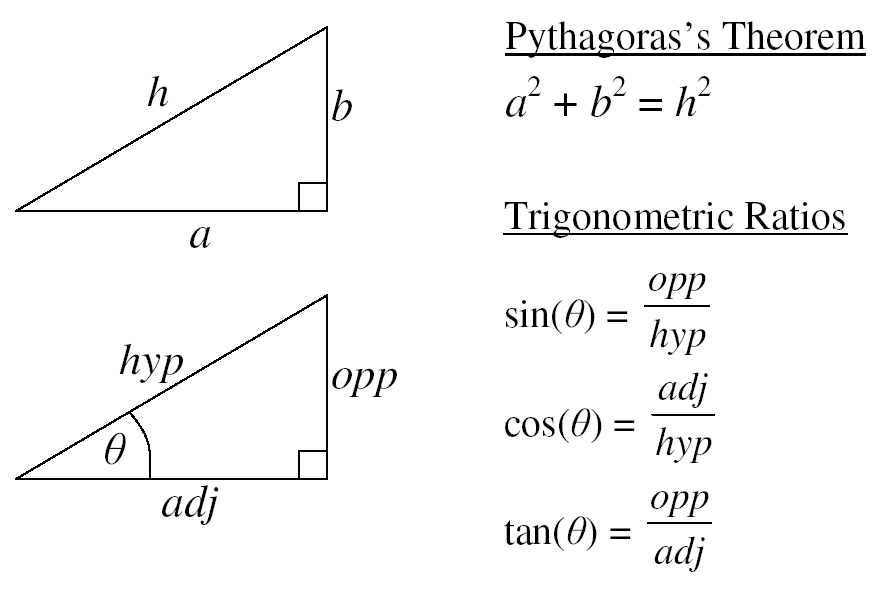
Unit Circle
- A unit circle is a circle centered at (0, 0) with radius 1.
- Each point on the circle corresponds to an angle θ
- The coordinates of that point:
SIN
Imagine a circle a perfect round shape with radius 1.
- Pick a point on the edge of this circle by starting at the rightmost point (0 degrees) and rotating by an angle θ
- This point has coordinates (x,y)(x, y)(x,y).
Now:
- The vertical height of this point from the center is called sin theta
- If you drop a straight line down from this point to the horizontal axis (x-axis), the length of that line is sin theta
Cosine: cos(θ) is the x-coordinate
That horizontal distance from the center to the point is cos(θ)\cos(\theta)cos(θ)
Tangent: tan(θ) is the slope
If you extend this line, it intersects the vertical line at x=1x = 1x=1 (right of the origin). That point of intersection has a height = tan(θ).
Tangent tells you how steep the angle is — it’s the ratio of vertical to horizontal motion. In physics, this is often used to resolve force vectors or trajectory slopes.
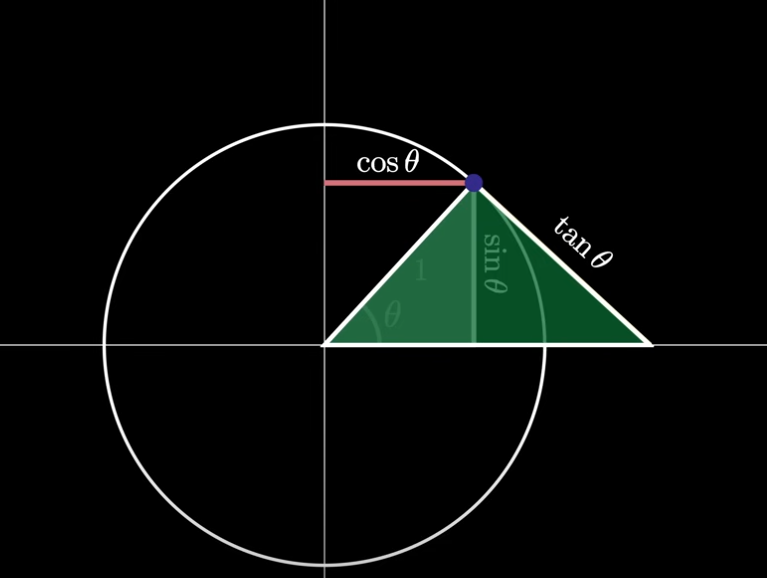
SIn → X height
| Angle | Radians | sin(θ) | cos(θ) | tan(θ) |
|---|---|---|---|---|
| 0° | 00 | 0 | 1 | 0 |
| 90° | π2\frac{\pi}{2} | 1 | 0 | undefined ↑ |
| 180° | π\pi | 0 | -1 | 0 |
| 360° | 2π2\pi | 0 | 1 | 0 |
These are usefull when we have triganle and only one vaule is know to us
NOTE: similar to algebra function sin,cos , tan are function which accept input and give output
What do sin(x), cos(x), and tan(x) do?
- They take an angle x (usually in degrees or radians) as input.
- They output a ratio — a number that compares the lengths of two sides of a right triangle related to that angle.
Why ratios?
- Ratios are scale-invariant. It doesn’t matter if the triangle is big or small the ratio of the sides stays the same for a given angle.
- This makes sine, cosine, and tangent universal functions tied only to the angle.
Calculs
The derivative rules, the chain rule, and partial derivatives are in Calculs.
| Branch | Question It Answers | Core Tool |
|---|---|---|
| Differential Calculus | “How fast is something changing right now?” | Derivative |
| Integral Calculus | “How much total change has occurred over time or space?” | Integral |
My notes
- Linear algebra function where if we able to form a equation for a data it will easy for us to find data at any point
fitting a linear function to data so that you can then compute unknown or future values. This is commonly used in:
- Linear regression (data science / statistics)
- System of linear equations (algebra)
- Vector spaces and transformations (pure linear algebra)