Classification of Systems
A system of linear equations can be:
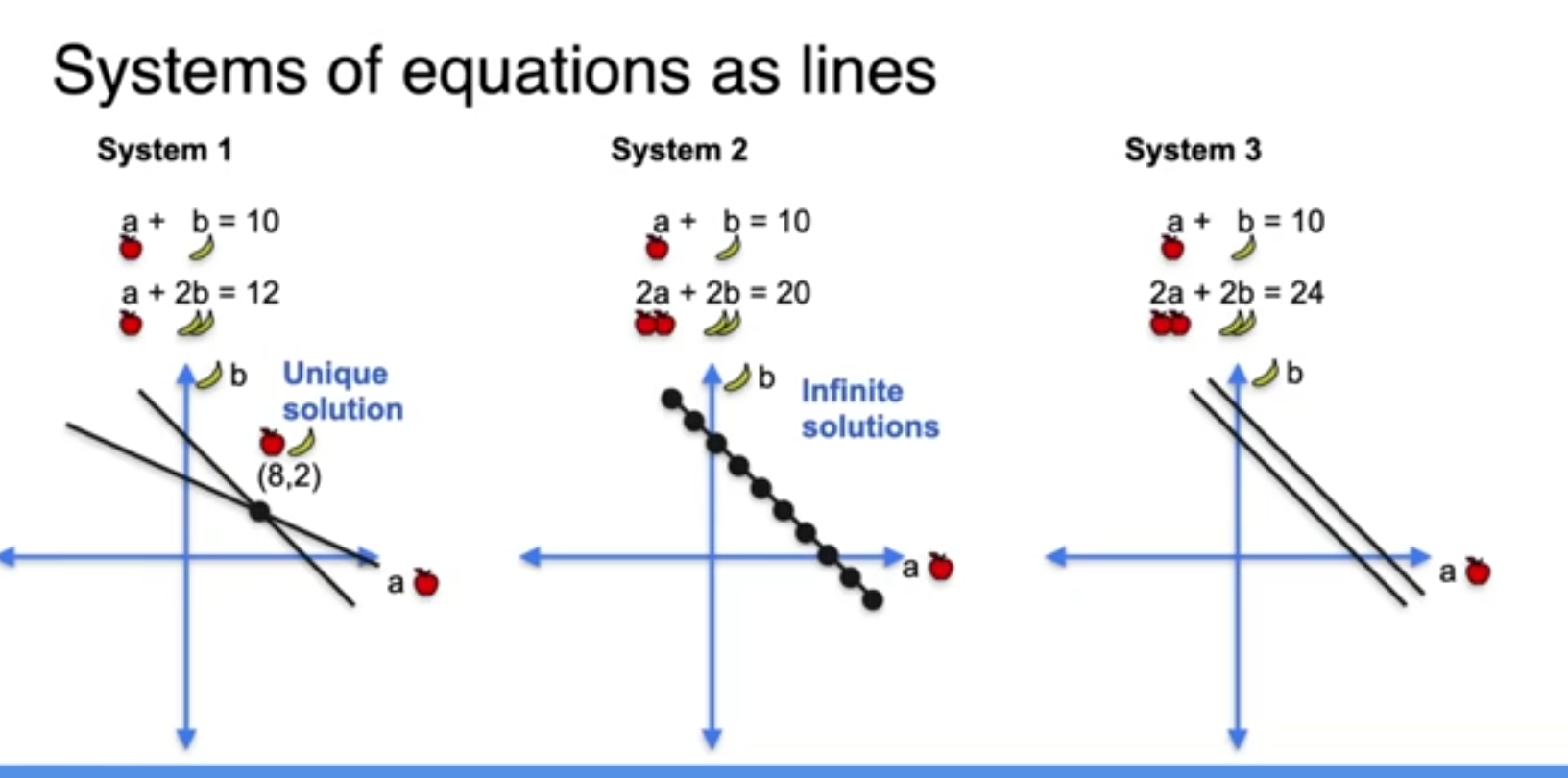
- Non-singular (Unique solution):
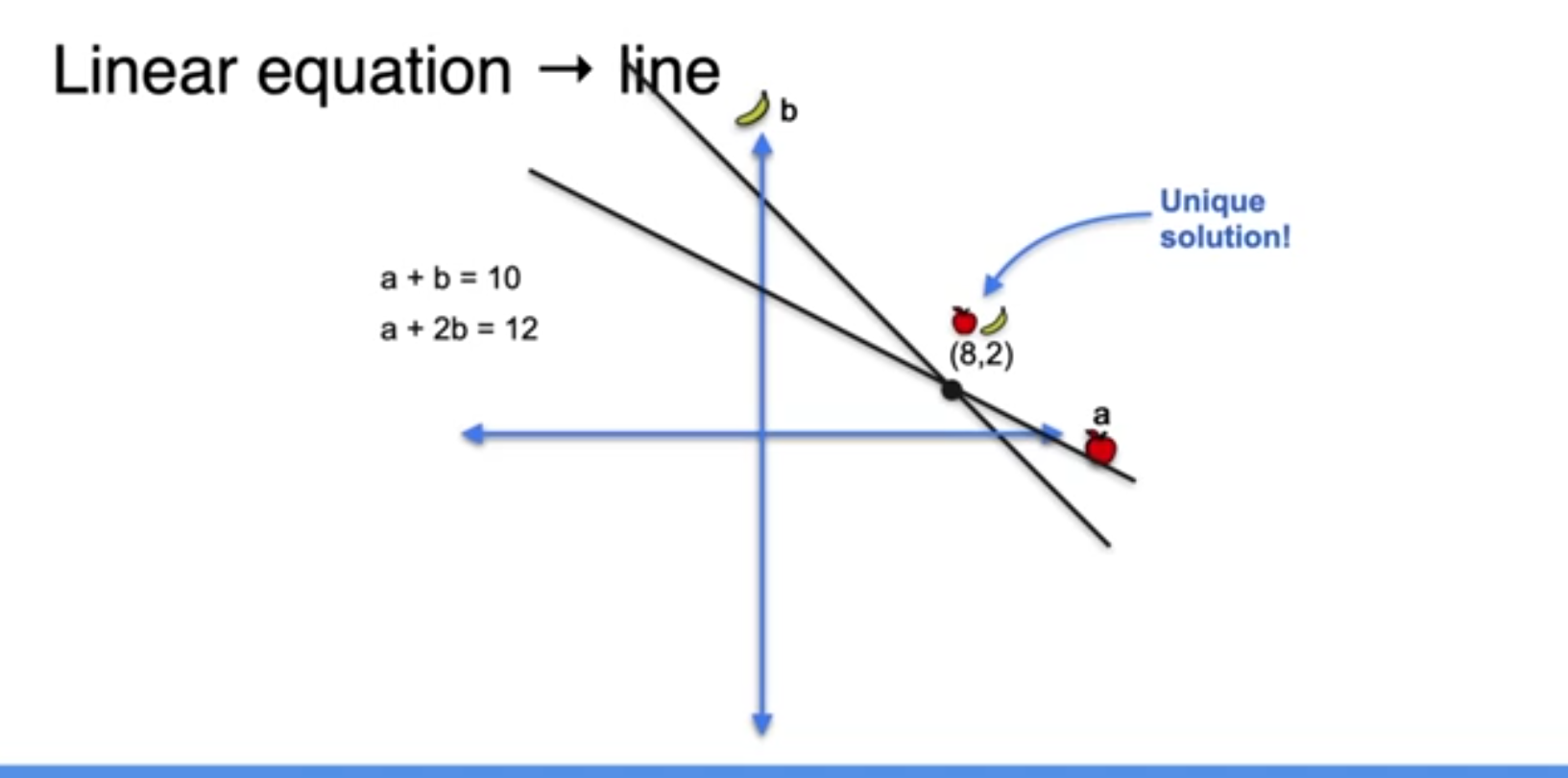
Each equation provides new information. Geometrically:
- 2D → two lines intersect at one point.
- 3D → three planes intersect at one point.
- Singular (No unique solution):
- Redundant (Infinite solutions): Equations overlap same line/plane repeated.
- Contradictory (No solution): Equations conflict parallel lines/planes.
Key fact: Constants (right-hand side values) shift the solution, but singularity depends only on the coefficient matrix.
Method 1 Manual Elimination
We can manipulate equations in three ways without changing the solution set:
- Multiply an equation by a non-zero constant.
- Swap two equations.
- Add/subtract a multiple of one equation to another.
These are exactly the row operations we’ll use in matrix form.
Solving by elimination
Step 1: Eliminate one variable
From (2): Multiply (2) by 2: Subtract from (1):
Step 2: Back-substitution
From (2): Solution: — unique, so non-singular.
Gaussian Elimination (Matrix Form)
Coefficient matrix:
Augmented matrix (add constants as last column):
Row operations
- Row swap:
- Row scale: ,
- Row replacement:
All preserve singularity and the solution set.
2.5.2 Goal forms
Row Echelon Form (REF):
- All non-zero rows above zero rows.
- Pivot (first non-zero number) in each row is to the right of the pivot above.
- Zeros below pivots.
Reduced Row Echelon Form (RREF):
- REF + each pivot = 1.
- Zeros above and below pivots.
RREF directly shows the solution.
Example in matrix form
Step 1: Swap rows so pivot is 1 at top:
:
Step 2: Eliminate below pivot:
:
Step 3: Scale pivot in :
:
Step 4: Eliminate above pivot in col 2:
:
This is RREF. Solution is .
Detecting Singular Systems in Gaussian Elimination
- Redundant (Infinite solutions):
Last row becomes — trivial equality .
- Contradictory (No solution):
Last row becomes with — false statement.
Example — Redundant:
Row reduction → last row: .
Example — Contradictory:
Row reduction → last row: .
Rank of a Matrix
Definition: The rank is the number of pivots in the REF form.
- Full rank: Rank = number of rows → non-singular.
- Less than full rank: Singular.
Example:
Rank = 2 → non-singular.
2.8 Determinants and Singularity
For 2×2:
- det ≠ 0 → non-singular.
- det = 0 → singular.
For 3×3, formula is more complex but same principle holds.
TODO form youtube to notbook llm add notes