
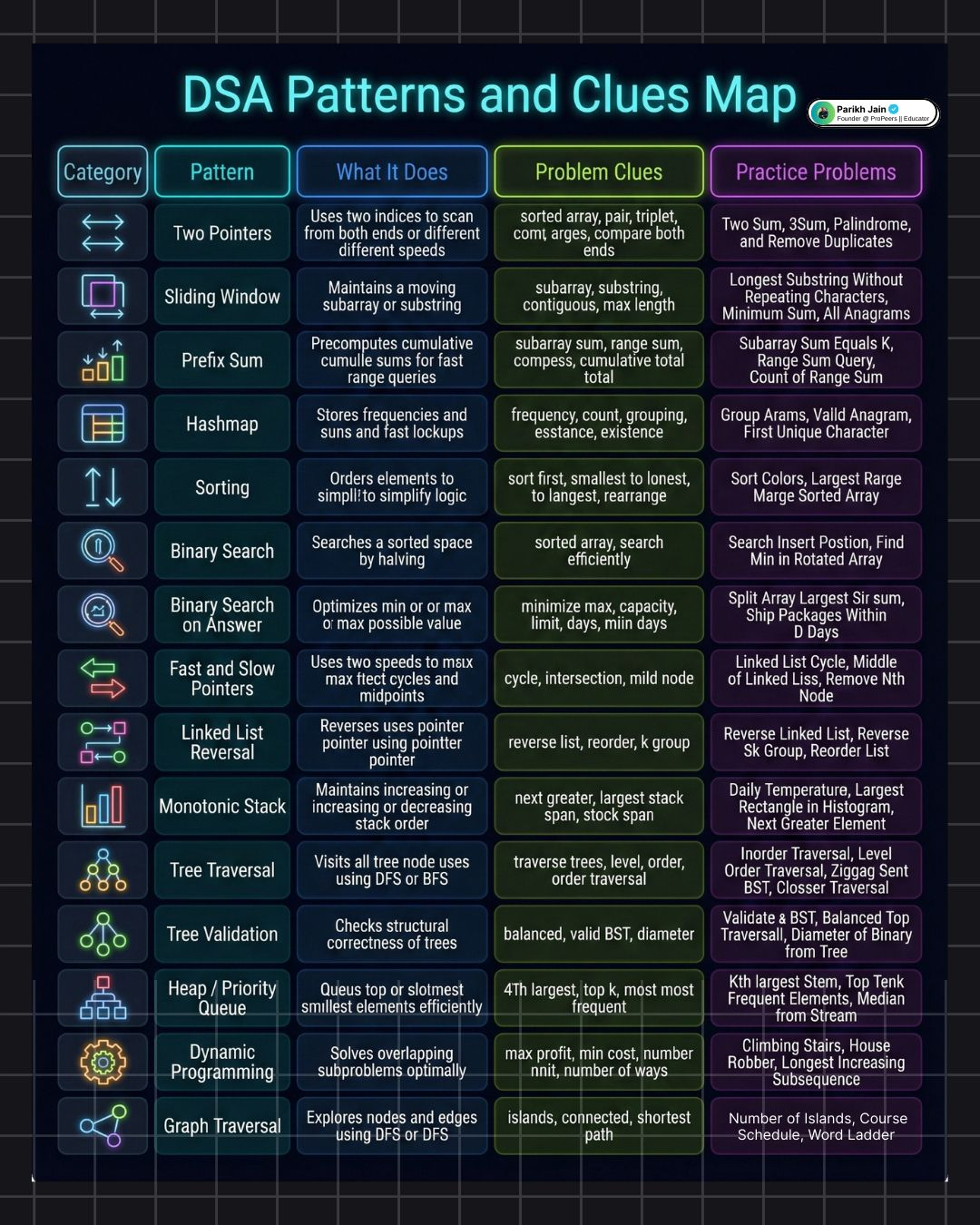
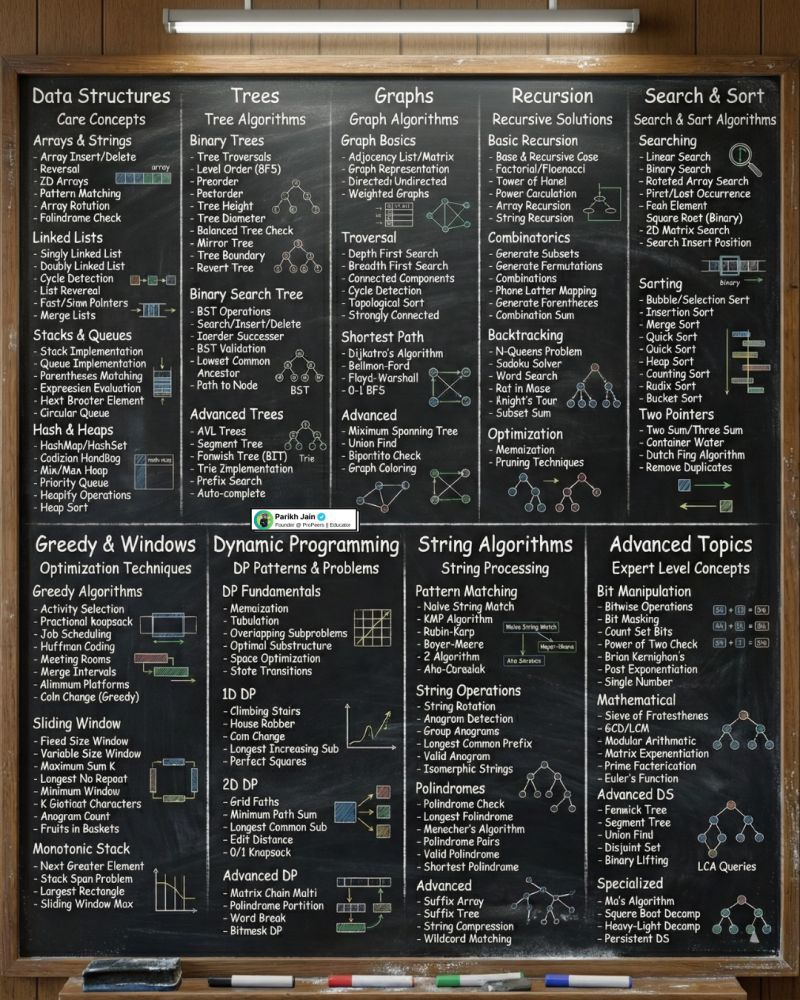
TIps in DSA
- Ask clarify question before start etc.
- first add basic condition and return
- Give proper varaiables etc
- Explain your logic and thought process if we have more then one apporach tell why we choose this apporach what make how it differes etc
Best one to follow
Two pointer approach
- two moving pointer at diff speed
- two are in same direction
- Opposite direction
we need to take decsion based on condition when we want to shrink the pointer from left or right
for Max Water Hold problem we move pointer based on which is lesser
Array
Pre compute technique
Prefix sum is a technique where we pre-compute cumulative sums of an array to answer range queries efficiently.
“What’s the sum of elements from index i to j?”
- if we precompute a prefix sum array to answer each in
O(1)time.
| Problem Type | Example Problems |
|---|---|
| Basic Traversal | Sum, Max/Min, Reverse |
| Searching | Linear Search, Binary Search |
| Sorting | QuickSort, MergeSort, Bubble Sort |
| Prefix Sum | Range Sum Query, Subarray Sum |
| Sliding Window | Max sum subarray, Longest substring without repeating chars |
| Two Pointers | Pair Sum, Container With Most Water |
| Hashing (Map/Set) | Two Sum, Longest Consecutive Sequence |
| Binary Search on Answer | Koko Eating Bananas, Capacity to Ship Packages |
| Greedy | Min Platforms, Merge Intervals |
| Kadane’s Algorithm | Maximum Subarray Sum |
| Subarrays/Subsets | Count/Generate Subarrays, Subset Sum |
| Backtracking | Subsets, Combination Sum |
| Bit Manipulation | Find Single Number, XOR Tricks |
| Prefix XOR | Count of subarrays with XOR = K |
| Monotonic Stack | Next Greater Element, Histogram Area |
| Union Find (Disjoint Set) | Detect Cycles in Graphs (if grid based) |
| DP (on Array) | House Robber, Max Product Subarray |
| Divide & Conquer | Maximum Subarray (recursive) |
| Counting/Indexing | Counting Sort, Inversion Count |
| Rotations/Shifts | Rotate Array, Cyclic Sort |
Monotonic stack
A Monotonic Stack is a special kind of stack where elements are kept in monotonic (increasing or decreasing) order.
- Next Greater Element
- Previous Smaller Element
- Largest Rectangle in Histogram
- Daily Temperatures
- Stock Span Problem
pattern
for (let i = 0; i < arr.length; i++) {
  while (stack.length && (condition based on arr[i] and stack top)) {
    // Do something with stack.pop()
  }
  stack.push(i);
}
const nums = [300, 4, 2, 1, 5, 3, 400];

const stack = [];
const result = Array(nums.length).fill(-1);  // Array to store the result

for (let i = 0; i < nums.length; i++) {
  // While stack is not empty and current element is greater than stack's top
  while (stack.length && nums[i] > nums[stack[stack.length - 1]]) {
    const index = stack.pop(); // Get index of the previous smaller element
    result[index] = nums[i];   // Set the next greater element for that index
  }
  stack.push(i);  // Push current element's index onto the stack
}

console.log(result);  // Output the next greater elements

	[
  400,   5,  5, 5,
  400, 400, -1
]
HEAP
A heap is a special kind of binary tree used mainly for priority queues and efficient sorting (like in Heap Sort). It has these main properties:
-
Complete Binary Tree
- Every level is fully filled except possibly the last.
- Last level has all nodes as left as possible.
-
Heap Property
Two types:- Max Heap: Every parent node is greater than or equal to its children.
- Min Heap: Every parent node is less than or equal to its children.
Implement a heap using an array (no need for pointers!):
- For index
i:- Left child → at
2i + 1 - Right child → at
2i + 2 - Parent → at
(i - 1) // 2
- Left child → at
        30
      /    \
    15      25
   /  \     /
  5   10   20
Insertion
- when inserting the element insert the element in last index array and do compare with parent until condition match and swap such that we will not get holes array
        30
      /    \
    15      25
   /  \     /


- Let we going to insert a new number it need to be from left such that when we store that in array it wont create holes
[30,15,25,5]
Deletion
-
Remove root node and replace the last node to root node and do the comparsion from root node until no issue
-
If we want sorted array we need to remove one element by one element and do heapfiy
class Heap {
  constructor(compare) {
    this.data = [];
    this.compare = compare; // (a, b) => a < b for MinHeap, a > b for MaxHeap
  }

  parent(i) { return Math.floor((i - 1) / 2); }
  left(i) { return 2 * i + 1; }
  right(i) { return 2 * i + 2; }

  swap(i, j) {
    [this.data[i], this.data[j]] = [this.data[j], this.data[i]];
  }

  push(value) {
    this.data.push(value);
    this.heapifyUp(this.data.length - 1);
  }

  pop() {
    if (this.data.length === 0) return undefined;
    if (this.data.length === 1) return this.data.pop();
    const root = this.data[0];
    this.data[0] = this.data.pop();
    this.heapifyDown(0);
    return root;
  }

  peek() {
    return this.data[0];
  }

  heapifyUp(i) {
    while (i > 0) {
      const p = this.parent(i);
      if (this.compare(this.data[i], this.data[p])) {
        this.swap(i, p);
        i = p;
      } else break;
    }
  }

  heapifyDown(i) {
    const n = this.data.length;
    while (true) {
      let best = i;
      const l = this.left(i);
      const r = this.right(i);

      if (l < n && this.compare(this.data[l], this.data[best])) best = l;
      if (r < n && this.compare(this.data[r], this.data[best])) best = r;

      if (best !== i) {
        this.swap(i, best);
        i = best;
      } else break;
    }
  }
}

// Usage:
// const minHeap = new Heap((a, b) => a < b);
// const maxHeap = new Heap((a, b) => a > b);
Sorting
- Bubble sort
- Swap two elements until no swap needed
- Selection sort
- Select pick smalles element and put to new array and repeat that on pick min from array
- Insertion sort
- Pick one number and find the right place to insert
 Let’s trace through this:

**Initial Array:** `[5, 3, 4, 1, 2]`

- **Pass 1:** key = 3 → insert before 5 → `[3, 5, 4, 1, 2]`

- **Pass 2:** key = 4 → insert before 5 → `[3, 4, 5, 1, 2]`

- **Pass 3:** key = 1 → move 5, 4, 3 → `[1, 3, 4, 5, 2]`

- **Pass 4:** key = 2 → move 5, 4, 3 → `[1, 2, 3, 4, 5]`
-
Merge sort
- Split ➡ Sort ➡ Merge
-
Quick sort
- Pick a pivot (any element from the array).
- Partition the array into two parts:
- Elements less than the pivot.
- Elements greater than or equal to the pivot.
- Recursively apply the same steps to the left and right parts.
- Combine the results.
-
Heap sort
-
Couting sort
Buket sort
- Number line divided into segments
- Mapping function routes each value to its segment
- Segments are inherently ordered
- Only local disorder is fixed inside each segment
Sorting by location first, comparison second.
complexity approaches O(n)
function bucketSort(arr, bucketSize = 5) {
  if (arr.length === 0) return arr;

  let min = Math.min(...arr);
  let max = Math.max(...arr);

  let bucketCount = Math.floor((max - min) / bucketSize) + 1;
  let buckets = Array.from({ length: bucketCount }, () => []);

  for (let num of arr) {
    let index = Math.floor((num - min) / bucketSize);
    buckets[index].push(num);
  }

  return buckets
    .map(bucket => bucket.sort((a, b) => a - b))
    .flat();
}
Frontend
- https://www.greatfrontend.com/front-end-system-design-playbook/types-of-questions
- https://frontendlead.com/system-design/frontend-system-design-interview-guide
binary search
In binary search, the midpoint is usually found as mid = (l + h) / 2.
However, if l and h are very large, their sum (l + h) might exceed the maximum integer limit and cause overflow.
To prevent this, we use:
mid = l + (h - l) / 2
Why it works:
(h - l)is always smaller than(l + h), so it stays within range.- Adding
lafter halving ensures the midpoint is still correctly positioned betweenlandh.
Short definition:
A safe way to compute the midpoint in binary search that avoids integer overflow.
The Core Insight of Binary Search
At its heart, binary search is not about arrays it’s about searching in any ordered space where you can test whether the solution lies to the “left” or “right” of some midpoint.
So, if:
- You know the answer lies between two bounds — say, between
lowandhigh, and - You can ask a yes/no question at a midpoint
midlike “is the solution smaller or larger than this?”,
then we can repeatedly halve the search space until you find the answer.
That’s the abstract idea and it works even outside of arrays.
Applying That Idea to Finding a Square Root
Let’s find √100 using binary search.
We know:
- The answer lies between
low = 0andhigh = 100. - If we pick any
mid, we can test:- If
mid * mid == 100→ we found it. - If
mid * mid < 100→ the true square root must be larger (move right). - If
mid * mid > 100→ the true square root must be smaller (move left).
- If
That’s exactly the same left/right decision rule used in binary search on arrays only now, the comparison is based on the square of mid.
Bitwise
find not repating number in array we can use XOR
Because XOR doesn’t depend on order it’s commutative and associative:
a ⊕ b ⊕ a ⊕ b ⊕ c = c
function findSingleNumber(arr) {
  let result = 0;
  for (let num of arr) {
    result ^= num;
  }
  return result;
}

console.log(findSingleNumber([1, 1, 2, 3, 3, 4, 4])); // 2
But if the array is sorted we can use binarysearch and which is log n
TWO pointer
- where to init
- how to update which one to move and when to stop
Use elimination logic — each comparison lets you confidently discard part of the search space by moving one pointer while keeping the other.
The reasoning steps:
- Initialize: Place pointers at strategic positions (often start/end or both at start)
- Evaluate: Check the current state (sum, comparison, condition)
- Decide: Based on the evaluation, determine which pointer to move
- Eliminate: Moving a pointer guarantees you’re not missing solutions (this is key!)
- Converge: Pointers move toward each other or scan the structure until done
If naive solution involves nested loops over the same structure, ask: “Can I eliminate parts of the search space based on comparisons?”
intersection of two array
- if it is sorted we can use two pointer
Montonic
Monotonic properties relate to the consistent, one-directional behavior of a function, sequence, or system as its inputs or elements increase. A property is monotonic if it is either entirely non-increasing or entirely non-decreasing across its entire domain or a specific interval
Hashing
- replicating substring
Recursion
- we need to reapet same step so figure it out one step that need to repat and do.
Sliding window
-
Subarray,substring we need to go with this and the answer must need to continous (if we combine a subarray to get sum etc.)
- We need to know when to shrink our window and how
-
Max subarray sum
-
count of anagram
Arrays
Maximum Product Subarray
why this algorithm exists and why it looks “strange”, you need clarity on these concepts:
- Contiguous subarrays and how they differ from subsequences
- Why brute force is too slow for subarray problems
- Dynamic programming as “carry forward best partial solutions”
- How multiplication behaves:
- sign flips with negatives
- zero as a reset element
- Why tracking only one “best so far” fails for products
We want:
The maximum product of any contiguous subarray.
Unlike sum, multiplication has dangerous behavior:
- Negative × Negative = Positive
- Zero wipes everything
- A very small negative can become very large when multiplied by another negative later
So a simple “keep the largest product so far” is insufficient.
Why naive thinking fails
Let’s say we tried this logic:
“At each index, keep the largest product ending here.”
This fails because:
- A large negative product might be terrible now but excellent later if multiplied by another negative.
So the system must remember:
- The maximum product ending here
- The minimum product ending here
Why minimum? Because it might become the maximum after sign flip.
This is the key insight.
At every position i, we ask:
What is the maximum product subarray that MUST end at index i?
Three possibilities:
- Start fresh at nums[i]
- Extend previous max: max * nums[i]
- Extend previous min: min * nums[i] (important when nums[i] is negative)
So:
newMax = max(nums[i], max * nums[i], min * nums[i]) newMin = min(nums[i], max * nums[i], min * nums[i])Then:
- update global result using newMax
- move forward
This makes the algorithm O(n) while still exploring all meaningful paths.
int min = nums[0];
int max = nums[0];
int result = max;

for(int i = 1; i < nums.length; i++){
    int cur = nums[i];

    int temp = Math.max(cur, Math.max(max * cur, min * cur));
    min = Math.min(cur, Math.min(min * cur, max * cur));
    max = temp;

    result = Math.max(result, max);
}
Dynamic programming
It is nothing but recurssion of graph and memory where we do same thing again and again
Let say we have coins 2,3,5 and we need to find the no of ways we can make 8
so let say 2 is the last coin if we add that we get our target then we have 6 ruppe balance in that 6 rupee we need to how many ways using 2,3,5 we can form 6 rupee and list will go keep
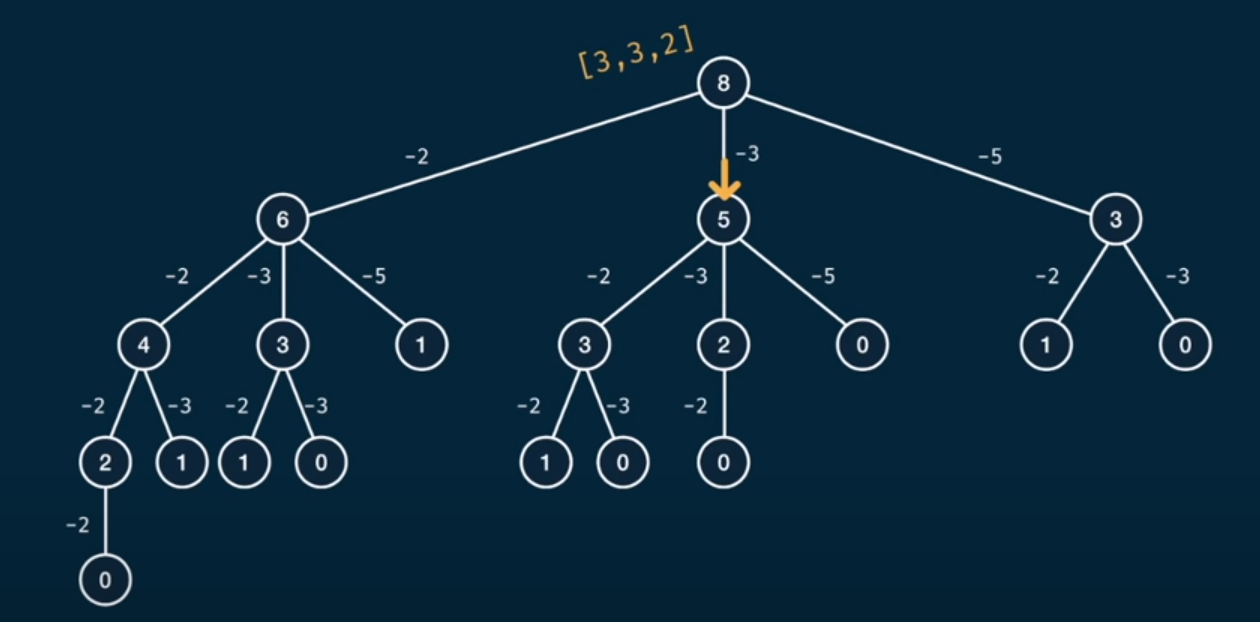
It is permutaion problem where we see same computation is done in multiple place instead of doing each time we can cache it
function howManyWays(target, coins) {
  const memo = {}; // memo[x] = number of ways to make x

  function dfs(remaining) {
    // If we already computed this value, return it
    if (memo[remaining] !== undefined) {
      return memo[remaining];
    }

    // Base case: exactly 0 remaining means 1 valid sequence
    if (remaining === 0) return 1;

    // If negative, no solution
    if (remaining < 0) return 0;

    // Try all coins as first coin
    let ways = 0;
    for (const c of coins) {
      ways += dfs(remaining - c);
    }

    memo[remaining] = ways; // store the result
    return ways;
  }

  return dfs(target);
}

console.log(howManyWays(5, [1, 4, 5])); // Output: 4
if we need min sum
function minCoins(target, coins) {
  const memo = {};  // memo[x] = min coins to make x

  function dfs(remaining) {
    // If already computed
    if (memo[remaining] !== undefined) {
      return memo[remaining];
    }

    // If we hit exactly zero → no more coins needed
    if (remaining === 0) return 0;

    // If negative → invalid
    if (remaining < 0) return Infinity;

    let best = Infinity;

    // Choose the coin that leads to minimum remaining coins
    for (const c of coins) {
      const result = dfs(remaining - c);
      best = Math.min(best, result + 1); // +1 because we used a coin
    }

    memo[remaining] = best;
    return best;
  }

  const ans = dfs(target);
  return ans === Infinity ? -1 : ans; // If impossible
}

console.log(minCoins(5, [1, 4, 5])); // Output: 1
This similar to
minCoins(x) = 1 + min(
    minCoins(x - 1),
    minCoins(x - 4),
    minCoins(x - 5)
)
Backtracking vs DP
BACKTRACKING = Generate / Explore all possibilities
- exploring all combinations, subsets, permutations
- searching through a decision tree
- producing all valid solutions
- path construction
Backtracking = YES/NO branching at each step.
✔ DP = Optimize / Count / Decide
DP answers:
- “Is it possible?”
- “What is the best?”
- “How many ways?”
- “What is the minimum cost?”
- “What is the maximum score?”
- “What is the longest/shortest?”
DP = compressing the search tree into states to avoid recomputation.
Strings
Palindrome
- A plaindrome is nothing but except center they have common things
Every palindrome has:
- Odd length: one center (e.g.,
"abcba"→ center atc) - Even length: two-center boundary (e.g.,
"abba"→ center between the twob’s)
Palindromic Substrings
var countSubstrings = function(s) {
    let count = 0;

    function expand(l, r) {
        while (l >= 0 && r < s.length && s[l] === s[r]) {
            count++;
            l--;
            r++;
        }
    }

    for (let i = 0; i < s.length; i++) {
        expand(i, i);       // odd
        expand(i, i + 1);   // even
    }

    return count;
};
Heap
A binary heap is a complete binary tree that satisfies a heap property:
- Min-heap: Every parent ≤ its children → smallest element is always at the root.
- Max-heap: Every parent ≥ its children → largest element is always at the root.
Key consequences
- No ordering guarantee between siblings.
- Tree is filled level-by-level, left to right.
Array Representation (1-based indexing)
Index 0 is unused for clean mathematics.
For an element at index i:
- Left child =
2i - Right child =
2i + 1 - Parent =
floor(i / 2)
Array: [null, 20, 19, 17, 13, 15, 12, 16, 11, 10]

Tree view (max-heap):

          20 (1)
       /           \
    19 (2)        17 (3)
   /    \        /     \
13(4) 15(5)   12(6) 16(7)
 / \
11(8) 10(9)
Insert (Min-Heap Example)
- Append new value at end of array.
- Bubble up while it is smaller than its parent.
- Swap with parent until heap property holds.
Mechanism:
Insert x → place at end → while x < parent(x): swap
Remove (Min-Heap Example)
- Remove root (smallest).
- Move last element to root.
- Bubble down by swapping with smaller child until heap property holds.
Mechanism:
Remove root → replace with last → while node > child: swap with smaller child
Backtracking
Backtracking is a recursion pattern that:
- Maintains state variables describing a partial solution.
- Explores possible next choices by making those state updates and recursing.
- Detects invalid/complete states (prune or accept).
- Reverts the state (or uses immutable copies) to try the next choice.
Mechanically: recursion frames hold local copies (or you mutate+undo) of the state. You only descend into calls that satisfy constraints.
Generate all valid Parentheses
So let say if they give n=2 we need to generate all valid paranetessi
(()) ()()
Constraints reasoning
- We never allow
close > openat any prefix (that would be invalid). - We never allow
open > norclose > n.
Those are local constraints evaluating only on the current state, enabling pruning.
Every partial string is a node; edges are choosing '(' or ')'. The full space is a binary tree of depth 2n, but constraints prune huge parts of it. The number of valid leaves is the nth Catalan number (not exponential like 2^(2n) in practice for valid results).
Solution
- We need to construct strings length
2nusing'('and')'. - Let state be
(s, open, close)wheres= current string (lengthopen + close)open= number of'('usedclose= number of')'used
- Terminal condition: if
open + close == 2n, thensis complete → add to results. - Legal moves:
- Add
'('ifopen < n. - Add
')'ifclose < open(ensures prefix constraint).
- Add
- Why those moves are necessary:
- Must never exceed
nopens. - Must never close more than opened (local prune).
- Must never exceed
- Recursively apply choices; after returning, undo (if mutating) or let the recursion frame discard local copy.
These rules exactly capture minimal necessary constraints and will generate each valid string exactly once.
- State vector:
(s, open, close)— minimal sufficient information. - Invariant at every node:
0 ≤ close ≤ open ≤ nandlen(s) = open + close. - Why invariant matters: If
close > open, no completion can be valid — prune immediately. - What would break: Removing the
close < openrule will produce invalid strings and require post-filtering or more checks later. Removingopen < nwould try invalid opens beyond required and complicate termination.
// Generate Parentheses - LeetCode 22
function generateParenthesis(n) {
  const res = [];
  function backtrack(s, open, close) {
    if (s.length === 2 * n) {
      res.push(s);
      return;
    }
    // If we can still add '(' -> try it
    if (open < n) {
      backtrack(s + '(', open + 1, close);
    }
    // We can add ')' only if it won't break validity
    if (close < open) {
      backtrack(s + ')', open, close + 1);
    }
  }
  backtrack('', 0, 0);
  return res;
}

// Example
console.log(generateParenthesis(3));
// ["((()))","(()())","(())()","()(())","()()()"]
Generate All Subsets Whose Sum Equals a Target
we need take decsion does we need to include this number or not and keep tracking
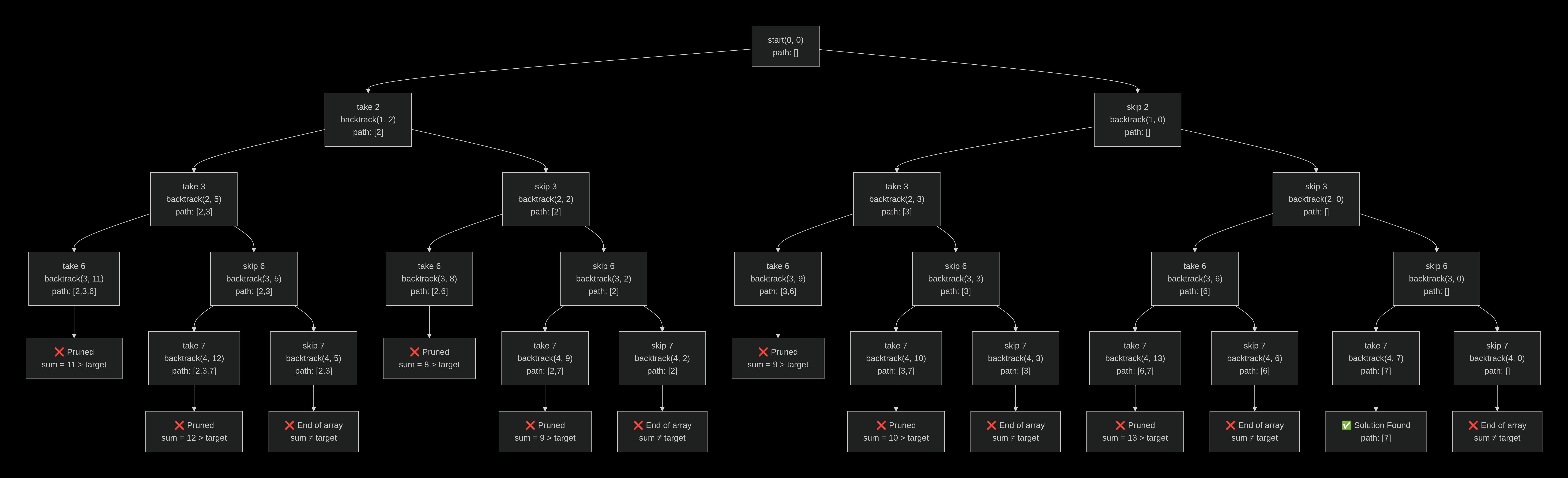
subset generation backtracking
It’s a method to generate all possible subsets (a.k.a. the power set) of a given set or array.
array = [1,2,3]
[], [1], [2], [3], [1,2], [1,3], [2,3], [1,2,3]bruteforce
function subsets(nums) {
  const res = [[]];
  for (const num of nums) {
    const len = res.length;
    for (let i = 0; i < len; i++) {
      res.push([...res[i], num]);
    }
  }
  return res;
}

console.log(subsets([1, 2]));
// Output: [ [], [1], [2], [1,2] ]
We iterating through each number and adding that number to exist subset and creating this as
- Time = O(n * 2^n)
Backtracking
function subsetsBacktrack(nums) {
  const res = [];

  function backtrack(index, path) {
    res.push([...path]);
    for (let i = index; i < nums.length; i++) {
      path.push(nums[i]);                 // include
      backtrack(i + 1, path);             // recurse
      path.pop();                         // exclude (backtrack)
    }
  }

  backtrack(0, []);
  return res;
}

console.log(subsetsBacktrack([1, 2]));
// Output: [ [], [1], [1,2], [2] ]


Start: []

├── [1]
│   ├── [1,2]
│   │   └── [1,2,3]
│   └── [1,3]
├── [2]
│   └── [2,3]
└── [3]


           []
         /    \
      [1]      []
     /   \    /   \
 [1,2] [1]  [2]   []


method2
function subsetsBacktrack(nums) {
  const res = [];

  function backtrack(index, path) {
    res.push(path);
    for (let i = index; i < nums.length; i++) {
      backtrack(i + 1, [...path, nums[i]]);
    }
  }

  backtrack(0, []);
  return res;
}

console.log(subsetsBacktrack([1, 2]));
- In recurrsio it go depth first and then comeback
Template for backtrack
- For backtrack problem we explore all path it just a decision tree where we take dicision does we need to include this number or not and we try explore path by include the number and not include by backtracking ,
- Some time we have constraint that will have some condition
Note:
We can achevie Backtracking in two ways
Backtracking is exactly DFS over an implicit tree where:
- each node = a state
- each edge = a decision
- each branch = a complete solution (or dead end)
There is no actual tree stored in memory recursion (or a manual stack) simulates DFS.
var generateParenthesis = function (n) {
  const result = [];
  const temp = [];

  function backtrack(openCount, closeCount) {
    // if we built a full sequence
    if (temp.length === n * 2) {
      result.push(temp.join(""));
      return;
    }

    // try adding "("
    if (openCount < n) {
      temp.push("(");
      backtrack(openCount + 1, closeCount);
      temp.pop();
    }

    // try adding ")"
    if (closeCount < openCount) {
      temp.push(")");
      backtrack(openCount, closeCount + 1);
      temp.pop();
    }
  }

  backtrack(0, 0);
  return result;
};

console.log(generateParenthesis(3));
Triggering two children at the same time with different states
At any state, we can branch by generating:
- nextState1 → stack.push(nextState1)
- nextState2 → stack.push(nextState2)
Each child gets its own:
- updated partial solution (
temp) - updated decision counts (like openCount/closeCount)
- updated constraint state
This ensures branches are independent.
var generateParenthesis = function(n) {
  const result = [];

  function backtrack(curr, open, close) {
    if (curr.length === n * 2) {
      result.push(curr);
      return;
    }

    if (open < n) {
      backtrack(curr + "(", open + 1, close);
    }

    if (close < open) {
      backtrack(curr + ")", open, close + 1);
    }
  }

  backtrack("", 0, 0);
  return result;
};